Thursday, May 2, 2013

Far, Far Away


The more divided becomes music industry, the more complicated
becomes the process of listening and searching for the new music.
Demand for a unified solution is already there, but to gain power
a lot of things should happen in future.
Major labels will not let themselves stick to a device that will control
all the music through one service (iPod/iTunes), and they will support
new standards and services (e.g. Beats - curated subscription service)
in order to create competition.

The solution will be presented not as a device, but as a software, using
technology to search and subscribe/buy the music you want from any
source possible: Spotify, iTunes - you name it.

Unified search engine without attachment to a device will
store all your downloads in the cloud and will pay the shop
just using your ID. You will do it in the car, in the office,
or while running with your dog.

Little bit farther

With development of music-production technology, more and more people start to make money from music. Without a contract from a major label, artists have to sell their music by themselves. Royalty from subscription services are too small for a young producer to survive, and that's when indie labels and/or crowdfunding services come to the stage. With only 17% market share, independent album sales are raising, and there are stories of success already: Amanda Palmer (on photo) raised $1,2M on Kickstarter from fans willing her to record a new album.

Nearest future

For the first time since1999 music industry is rising (+0,3% in 2012).
http://www.ifpi.org/content/library/DMR2013.pdf - annual IFPI report.

It happened because of the digital sales and subscription services, which have 20 000 000 users globally, and new players, like Twitter #Music as well as rumoured iRadio and Google subscription service will increase this number even higher next 5 years.

2011 - Cloud number ...

iCloud and Google Music announced.

Now all the music that could be stored on hard drives of a users' personal computer, is stored in a Cloud and users can address to it from anywhere and any time, without attachment to a device.

2005-2008 - Recommendations

Another loop in music history, but in a different way: now there are on-demand radio stations that ask for subscription fee. The difference between modern radio stations and old ones is that now most of them use our own data to recommend us something new: similar artists, tracks, albums.

Rhapsody was started the first, then it was Last.fm in 2002, then Pandora in 2005, and then Spotify in 2008. 

2001 – iRevolution

iTunes was presented in January, and then, in October, the iPod.

iPod created a bigger revolution than Walkman 20 years before it, with only one difference - it is digital, and it means that copying and listening to the copied music files is easier than ever.

I really think that piracy wouldn't be that popular without iPod and other mobile devices that let people listen to the music that easy – Napster wouldn't be there if people wouldn't have device for their mp3's.

1999 – Nap.ster

Year 1999 was a wonderful year for Internet pirates.
First .mp3 players were announced, and a service called Napster was there to help poor boys and girls to  find the files absolutely for free. Some colleges even blocked it, because it overloaded student broadband channels with 61%  usage for mp3 files.
Anderson, Kevin (September 26, 2000). "Napster expelled by universities". BBC News.
Unfortunately, Napster wasn't in plans of major labels, who suited Napster with help of Metallica and Dr.Dre, forcing the service to quit and create a precedent for an anti-pirate lawsuits all over the world.

1995 – RealAudio

In 1995, Real Media introduces streaming internet audio, known by .rm format.

It was the best attempt to repeat radio success in Internet, and it was a great attempt, as the format was alive until late 2000's.
"Real Media format no longer available". BBC. Retrieved on 2013-02-05

1989 – WWW

It's interesting how world wide web can be slightly changed to get the "World War Web", isn't it?

In 1989, Internet becomes global (CERN opened its first external TCP/IP connections - ), and in the same year standard of .mp3 files for audio files was invented (Doctoral student at Germany's University of Erlangen-Nuremberg, Karlheinz Brandenburg began working on digital music compression in the early 1980s, focusing on how people perceive music. He completed his doctoral work in 1989.). This two events, after 12 years, led to the crash of a $40-billion music market to a 15-billion level.
Ben Segal (1995). A Short History of Internet Protocols at CERN. Retrieved on 01-05-2013.


Music industry would never be the same, but the interesting thing is that it would go to back in a strange loop, as now we buy mostly singles, not albums. And an artist can be commercially successive with just a 1 song, without LP's or EP's.

1982 – CDigital revolution

In 1982, Philips and Sony again created a revolution and introduced a Compact disc to the public. The first album was Billy Joel's "52nd Street".

It was a start of a digital era that killed records' and cassette' sales (especially after the release of Discman). Also, it was a first step to piracy as we see it today, as people could take their friends' discs and burn them onto their computers.

1981 – MTV

"Video killed the radio star" – it was the name of the song that started MTV broadcasting on January 1st, 1981.
"80Music.about.com". 80Music.about.com. 1981-08-01. Retrieved 2013-05-01.
Maybe MTV haven't killed radio, but it turned the industry into another direction, where looks matter even more than sounds. First negative experience is, probably, acclaimed band "Milli Vanilli", who were performing and recording videos using other ("background") artists' phonograms.


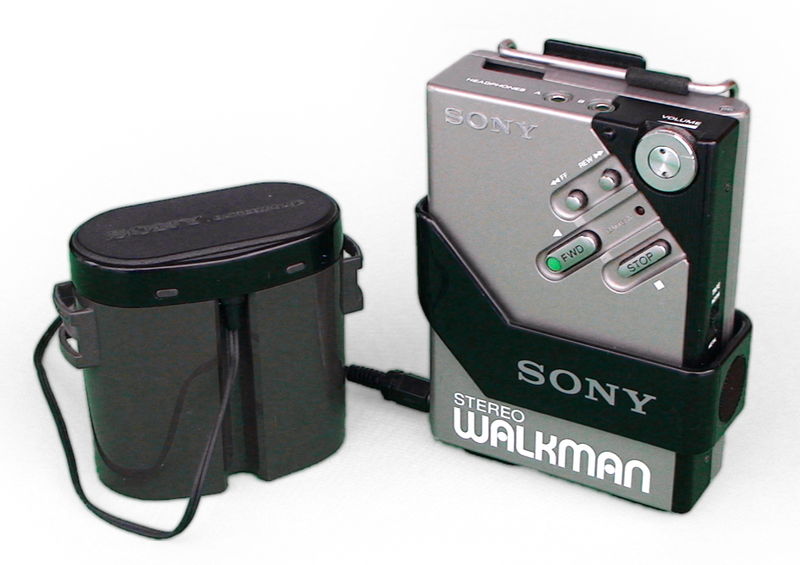
1978 – WALKMAN

In 1978, Sony introduced Walkman – first portable cassette player. The prototype was built in 1978 by audio-division engineer Nobutoshi Kihara for Sony co-chairman Akio Morita, who wanted to be able to listen to operas during his frequent trans-Pacific plane trips.
Hormby, Thomas (2006-09-15). "The Story Behind the Sony Walkman" Retrieved 01-05-2013


It was a revolution in industry, followed by creation of a number of clones by competitors such as Aiwa, Panasonic and Toshiba. Basically, first battle of a mass-market mobile audio devices turned into a hegemony of Walkman's, almost the same way it happened 25 years later with iPod.

1966 – Car-driven music

In September 1965, Ford Motor Company introduced factory-installed and dealer-installed eight-track tape players as an option on three of its 1966 models (Mustang, Thunderbird, and Lincoln) with an optional installation of an 8-track tape player.
"RCA Fires 175-Title Burst with Release of Stereo 8 Cartridges". Billboard 77 (39): 3. 25 September 1965.

It was another recognition of a music as a constant satellite to everything in a man's life, and a start to a beautiful friendship of the cars and music producers.

1963 – Compact Cassette

In 1963, Philips announces compact cassettes with magnetic tape. Although there were other magnetic tape cartridge systems, Philips' Compact Cassette became dominant as a result of Philips' decision in the face of pressure from Sony to license the format free of charge.
Hans-Joachim Braun, Music and technology in the twentieth century. JHU Press, 2002, p.161.
With this action Sony avoided the battle of formats and a mistake made by record companies in the 40's, when they spent 10 years to officially set an LP record as a standard for industry. It's funny though, that 50 years later, Sony would intentionally go into a battle of formats between BluRay discs and HD-DVD discs.

1954 – Regency TR-1

The Regency TR-1 was the first commercially manufactured transistor radio. First sold in 1954, it was a novelty due to small size and portability; about 150,000 units were sold despite mediocre performance. The device demonstrated the use of transistors for consumer electronics; previously transistors had only been used in military or industrial applications.
Smicoe, Robert J. "The Revolution in Your Pocket". Invention & Technology Magazine, Fall 2004, Volume 20, Issue 2. Archived from the original on 2006. Retrieved 2010-04-20.

It was a start of an era of truly portable devices helping people to listen to the music wherever they were.


1948 – LP's

In 1948 Columbia introduced the Long Playing "microgroove" LP record format (sometimes written "Lp" in early advertisements), which rotated at 33⅓ revolutions per minute, to be the standard for the gramophone record for half a century.

The 33's eventually caused one of the first real wars between similar formats of records. When the LP was introduced in 1948, the 78 was the conventional format for phonograph records. By 1952, 78s accounted for slightly more than half of the units sold in the United States, and just under half of the dollar sales. The 45, oriented toward the single song, accounted for 30.2% of unit sales and 26.5% of dollar sales. The LP represented 16.7% of unit sales and 26.2% of dollar sales.
"78 Speed On Way Out; LP-45 Trend Gaining", The Billboard, August 2, 1952, p. 47.

Ten years after their introduction, the share of unit sales for LPs in the U.S. was 24.4%, and of dollar sales 58%. Most of the remainder was taken up by the 45; 78s accounted for only 2.1% of unit sales and 1.2% of dollar sales.
Robert Shelton (March 16, 1958). "Happy Tunes on Cash Registers". The New York Times. p. XX14.

It took almost 10 years to set LP as a standard for music industry, but by 1954 RIIA and recording companies agreed to accept LP's as the most common format for a record, and in 1963 it was officially announced in RIIA bulletins.
http://www.aardvarkmastering.com/riaa.htm

1920 – KDKA


On November 2, 1920, in Pittsburgh, PA, first commercial radio station started its work in AM diapasone.
Excerpt from "Broadcasting's Oldest Stations: An Examination of Four Claimants" by Joseph E. Baudino and John M. Kittross. Journal Of Broadcasting, Winter, 1977, pp. 61-82

The station is still working today, and belongs to CBS Network.

1889 – music on demand

In 1889, Louis Glass and his partner, William S. Arnold, presented first coin-operated phonograph.
It Happened in Palais Royal Saloon at 303 Sutter St., in San Francisco. 
Athitakis, Mark. (1999). Riff Raff. Available: http://www.sfweekly.com/1999-12-01/music/riff-raff/. Last accessed 01-05-2013.

It's quite ironic that this machine, a predecessor of modern jukeboxes and, in some kind, of all the music/video subscription services operating now – was presented 110 years ago at the same state where most of the startups are situated in our days.

The presentation of a "nickel-in-the-slot phonograph" marked the start of an "artificial on-demand entertainment", where you can pay for the entertainment, but you still don't own it.
Glass's jukebox patent.

1887 – Gramophone

One of the most influential inventions of all time – The phonograph, record player, or gramophone, was invented in 1877 by Thomas Edison.
Gerald Beals. (1999). The Biography of Thomas Edison. Available: http://www.thomasedison.com/biography.html#phonograph. Last accessed 01-05-2013.


It can be considered the second death of music, arguably, as it was the first successful attempt to record and duplicate sound of human voice and music.

Gramophone became commercially available in 1890's, right in time to witness success of Lumiere brothers' cinematograph.

Wednesday, May 1, 2013

1811 – First industry change

The first technology impact on music itself – opening of a Chappell & Company store in London, 1811. Chappell & Company was the first ever shop to sell not only music instruments, but music sheets as well – letting everybody use the sheets and play all the popular compositions without asking a professional.

"Chappell & Co. beg leave to acquaint the nobility and gentry that they have taken the extensive premises lately occupied by Moulding & Co., 124 New Bond Street, and have laid in a complete assortment of music of the best authors, ancient and modern, as well as a variety of instruments, consisting of Grand and Square Pianofortes and Harps for sale or hire." – Morning Chronicle Jan 23, 1811.
Ref.: Chappell of Bond Street. (n/a). History of Chappell of Bond Street.
Available: http://www.chappellofbondstreet.co.uk/C~-1000~History-of-Chappell-of-Bond-Street. Last accessed 01-05-2013.

Musicians and composers os that age claimed that this kind of "technology" breakthrough will "kill the music", although in 1819 Ludvig Van Beethoven sent a letter to his friend praising Chappell & Co as "one of the best publishers" in the business.
Ref.: Boosey, William (1931). Fifty years of music. 6th ed. London: Ernest Benn Limited. 77.
Now Warner/Chappell is a part of a major publishing company – Warner Music Group.